

What are credit-based rewards?
An in-product credit reward is a non-monetary reward that can incentivize users within the product itself. Instead of rewarding a referrer with cash, you can reward successful referrals with free credits for your product.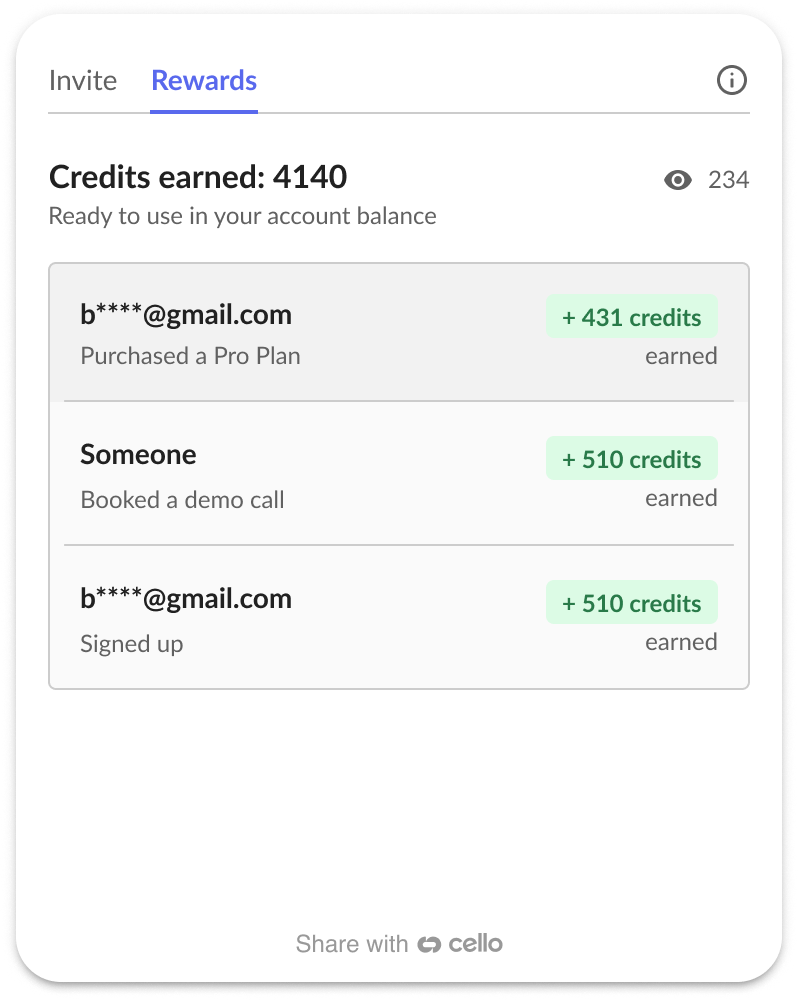
How will your platform be notified about new credits?
Cello provides a service that notifies your platform when a new credit reward is issued to a specific product user. Notifications are delivered as webhooks via HTTPS with Basic Auth for authentication.Webhook Implementation
Authentication
All webhook requests use HTTP Basic Auth:- Username: Will be provided by the Cello Support team.
- Password: Will be provided by the Cello Support team.
Endpoint URL
The endpoint URL for thesandbox and prod environment should be shared during implementation to the Cello Support team. In the future, this can be managed inside the Cello Portal.
HTTP Request
- Method:
POST - Headers:
Authorization: Basic base64({username}:{password})Content-Type: application/json; charset=utf-8X-Cello-Env: prod | sandbox
Event Payload
Delivery Semantics
Retry Logic
Every event is delivered at least once. If the initial attempt fails, Cello’s platform performs multiple retries. Failed events will move to a failure queue after all retry attempts are exhausted.Deduplication
eventIdis stable per reward and should be used for deduplication, it will not change between retry attempts